Plan your visit to Doge's Palace
Doge's Palace is the former seat of Venetian power, best known for its gilded council chambers, the Bridge of Sighs, and the prison route that completes the story. The visit feels more structured than sprawling, but it gets crowded fast because most people pair it with St. Mark's Square and nearby museums. The biggest difference between a rushed visit and a rewarding one is timing your entry before late-morning tour traffic builds. This guide covers arrival, tickets, pacing, and what to prioritize.
Quick overview: Doge's Palace at a glance
If you're deciding when to go, how long to stay, and whether to book more than standard entry, start here.
- When to visit: Daily, 9am–7pm. The first hour after opening is noticeably calmer than 11am–3pm, because St. Mark's Square combo tours and late-arriving day-trippers tend to converge then.
- Getting in: From €25 for standard entry. Guided tour options start from €32. Advance booking is smart from April to October, while winter visits are more forgiving if you're flexible on timing.
- How long to allow: 1.5–2 hours works for most visitors. It stretches closer to 3 hours if you add the prisons, armory, and the included San Marco museums.
- What most people miss: The Hall of the College gets overshadowed by the Grand Council Hall, and the armory near the end of the route is one of the easiest high-value stops to rush past.
- Is a guide worth it? Yes if you want the politics, trials, and secret-state backstory to make sense; if you mainly want the main chambers and Bridge of Sighs, an audio guide is usually enough.
🎟️ Secret Itineraries tours and popular morning slots for Doge's Palace can sell out several days in advance during April–October. Lock in your visit before the time you want is gone.
Jump to what you need
🕒 Where and when to go
🎟️ Which ticket is right for you?
🗺️ Getting around
🏛️ What to see
♿ Facilities and accessibility
📍 Rules and restrictions
Where and when to go
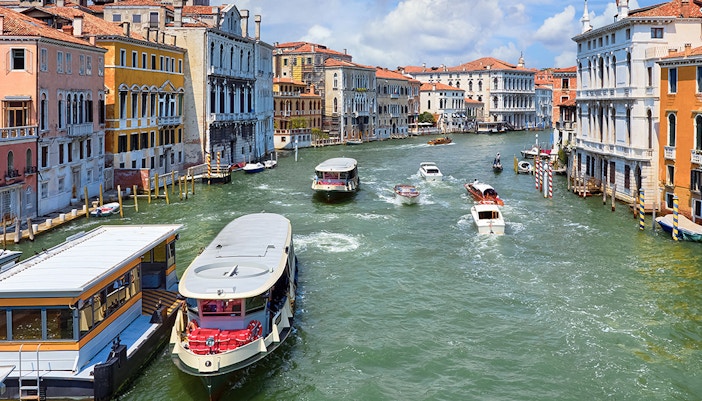
How do you get to Doge's Palace?
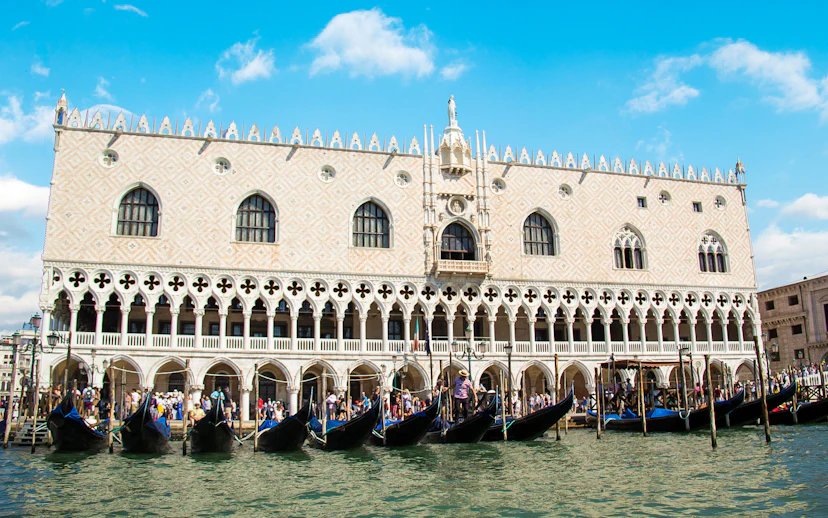
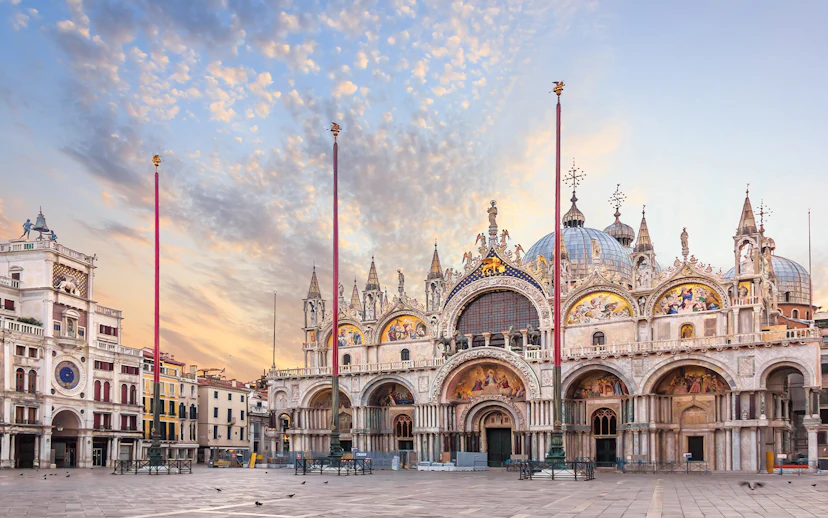
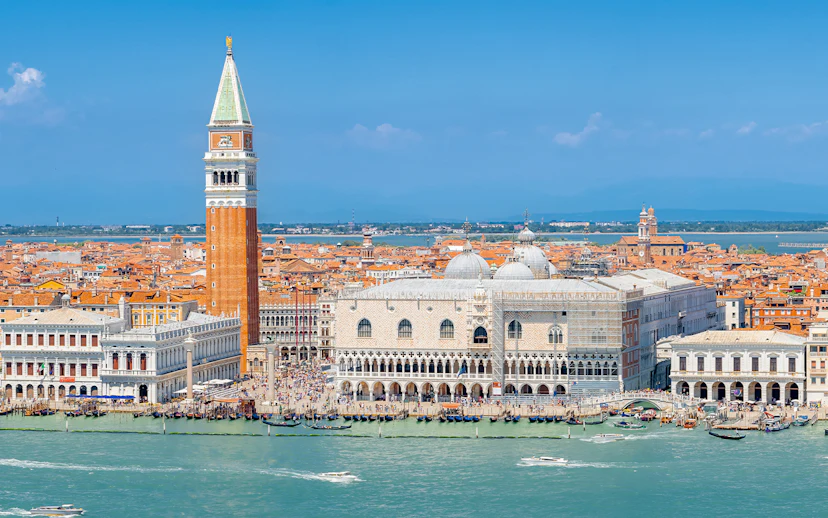
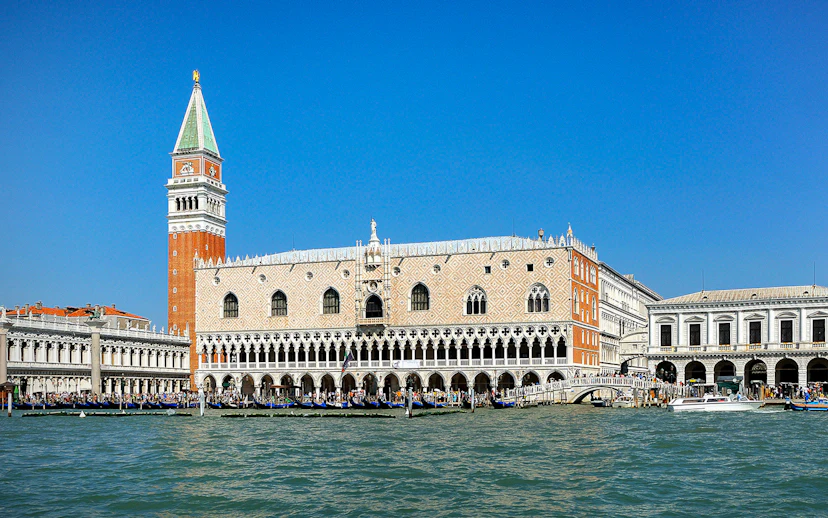
Doge's Palace sits at the eastern edge of St. Mark's Square, beside St. Mark's Basilica and a short walk from the lagoon-side vaporetto stops.
P.za San Marco, 1, 30124 Venezia VE, Italy
- Vaporetto: San Zaccaria stop → 5 min walk → Best if you're arriving from the station side or the lagoon islands.
- Vaporetto: San Marco Vallaresso stop → 6–8 min walk → Useful if you're already moving along the Grand Canal.
- Walking: Rialto area → 10–12 min → Follow signs for San Marco through the Mercerie.
- Water taxi: Molo San Marco drop-off → 3–5 min walk → Fastest direct arrival if you're coming with luggage or on a tight schedule.
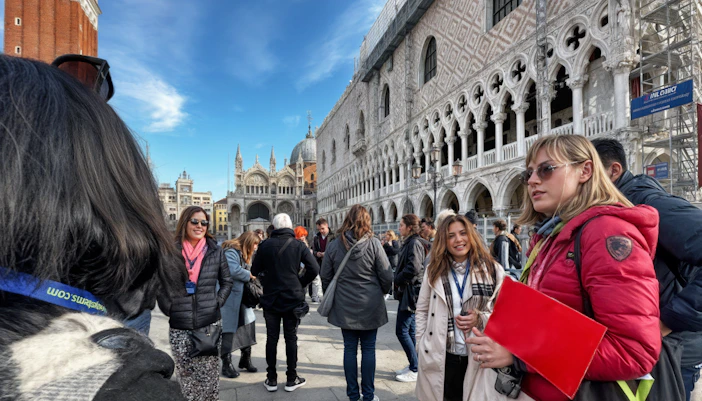
Which entrance should you use?
There is one main visitor entrance, but the wait depends more on your ticket type than on the door itself. The most common mistake is assuming 'skip the line' means skipping security too.
- Pre-booked tickets: For timed-entry and skip-the-line holders. Expect 5–15 min wait for security during late morning and early afternoon.
- On-the-day tickets: For same-day buyers and unresolved bookings. Expect 30–60 min waits in peak spring and summer windows.
Full entrances guide
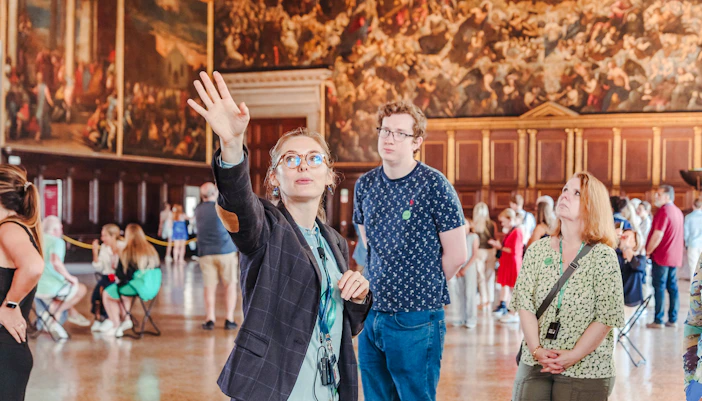
When is Doge's Palace open?
- Monday–Sunday: 9am–7pm
- December 25 and January 1: Closed
- Last entry: 6pm
When is it busiest? Late morning to mid-afternoon from April through October is the hardest window, with the heaviest build-up around 11am–3pm when St. Mark's Square tours overlap.
When should you actually go? Aim for opening time or the final 90 minutes of the day, when you can move through the Golden Staircase and main council rooms with less stop-start crowding.
Which Doge's Palace ticket is best for you
| Ticket type | What's included | Best for | Price range |
|---|---|---|---|
Doge's Palace Tickets | Timed entry + access to Museo Correr + access to the Archaeological Museum + access to the Monumental Rooms of the Biblioteca Marciana + optional audio guide/guided tour | A first independent visit where you want the palace route and the included San Marco museums without committing to a group schedule | From €25 |
Doge's Palace Skip The Line Tickets with Guide Book | Skip-the-line entry + entry to Museo Correr + entry to Museo Archeologico Nazionale + entry to Biblioteca Nazionale Marciana + physical guidebook + Venice map | A self-guided visit where you want structure and navigation help, but not a live guide setting the pace | From €25 |
Doge's Palace Skip The Line Guided Tour | Skip-the-line entry + expert guide + access to the Bridge of Sighs + access to the New Prisons + audio receiver/headsets | A first visit where the political history, trials, and symbolism of the rooms matter as much as the architecture | From €32 |
Doge’s Palace Tickets & 11-Museum Pass | Timed entry + Doge's Palace + Museo Correr + Archaeological Museum + Marciana rooms + Ca' Rezzonico + Ca' Pesaro + Natural History Museum + Murano Glass Museum + Burano Lace Museum + more | A multi-day Venice stay where you'll actually use the broader civic museum network instead of treating the palace as a one-stop visit | From €35 |
Doge’s Palace English Guided Tour with Secret itineraries access | Skip-the-line entry + guided tour + access to restricted palace areas + secret-state rooms + prison sections not on the standard route | A repeat or history-heavy visit where you want the palace's hidden machinery of power, not just the ceremonial rooms | From €32 |
How do you get around Doge's Palace?
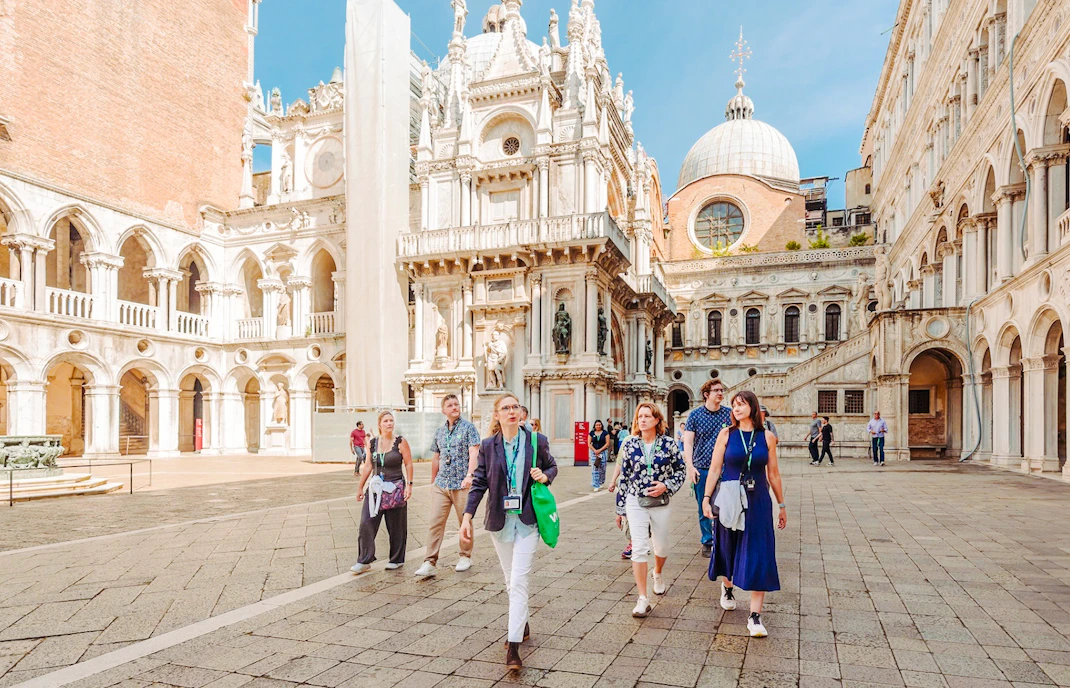
Inside the palace
Doge's Palace is a compact but sequential visit rather than a free-form museum. The route makes sense once you're inside, but it rewards slowing down in the state rooms instead of treating the Bridge of Sighs as the only headline stop.
- Courtyard and access level: Giants' Staircase, orientation, cloakroom, and lift access → budget 10–15 min.
- Golden Staircase and institutional rooms: ceremonial climb, Senate, College, and political chambers → budget 35–45 min.
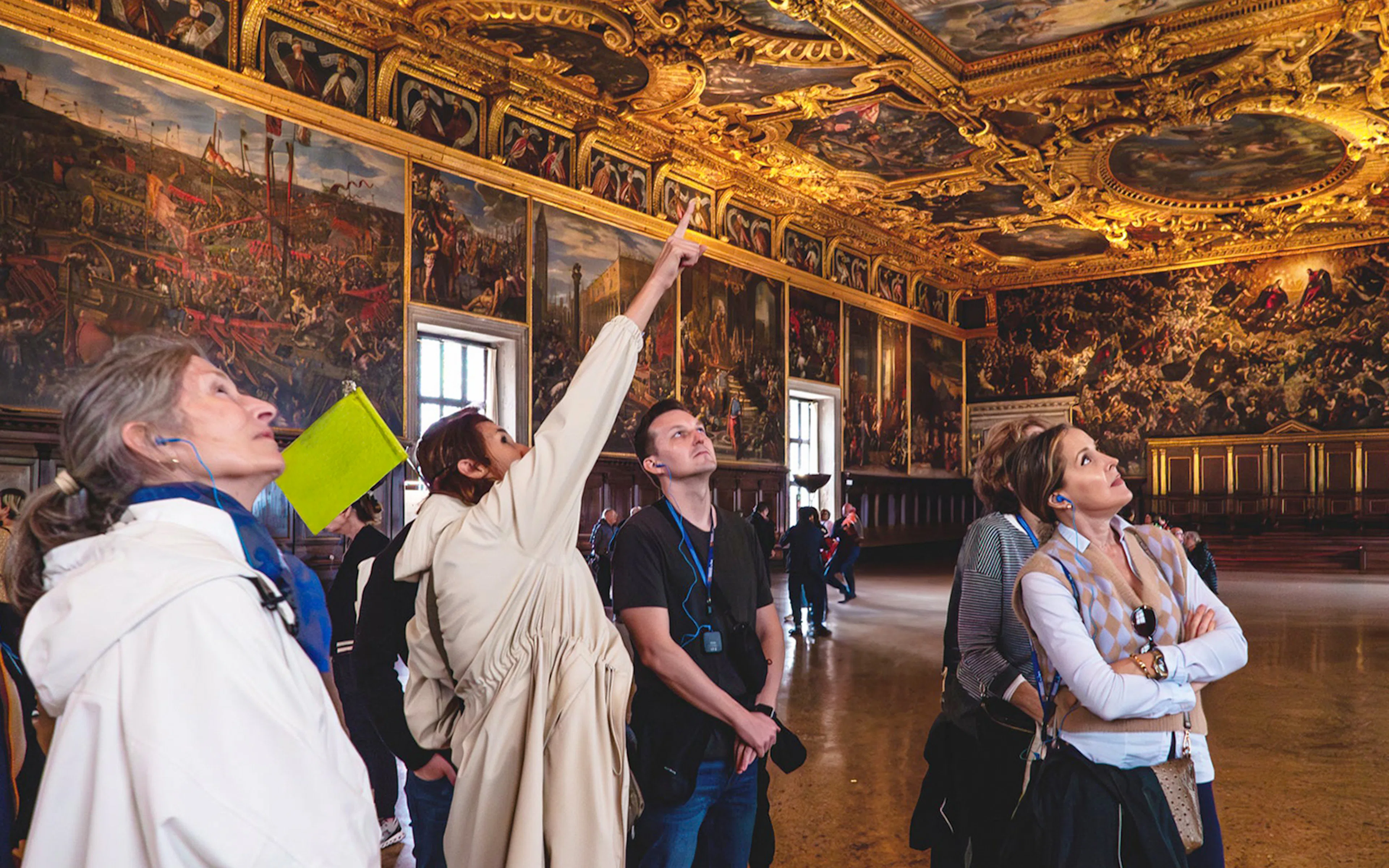
- Grand Council Hall zone: Tintoretto's Paradise, major ceremonial rooms, and key ceiling paintings → budget 20–30 min.
- Bridge of Sighs, prisons, and armory: the prison crossing, cells, and weapons collection near the exit → budget 20–30 min.
Suggested route: Start steadily through the institutional rooms, give the Grand Council Hall more time than you think, then finish with the prisons and armory — many visitors rush after the bridge and miss one of the palace's most revealing final sections.

Maps and navigation tools
- Map: On-site route maps and guidebook/app materials cover the standard visitor circuit → download or open them before arrival if you're using a phone-based guide.
- Signage: Wayfinding is good enough for the standard route, but it won't explain why each room matters, so a map or audio guide adds real value.
- Audio guide / app: Available on selected tickets and useful in multiple languages → best if you want context without joining a timed group.
- Large outdoor POIs only: Not applicable.
💡 Pro tip: Don't treat the Bridge of Sighs as the finish line — the armory comes after it, and it's one of the easiest strong sections to miss when the route starts thinning out.
Get the Doge's Palace map / audio guide
Where are the masterpieces inside Doge's Palace?
Grand Council Chamber
Artist: Jacopo Tintoretto and workshop
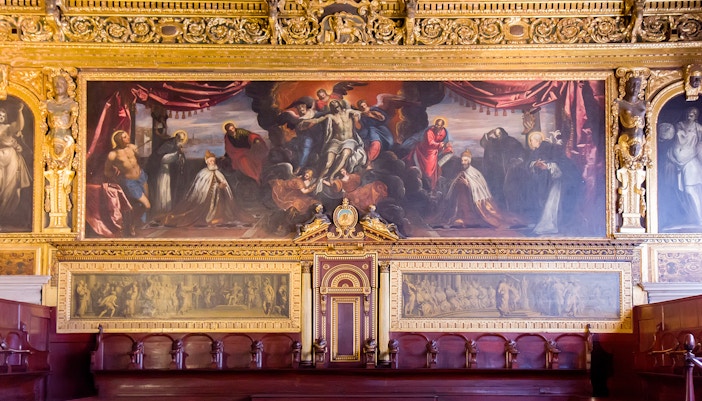
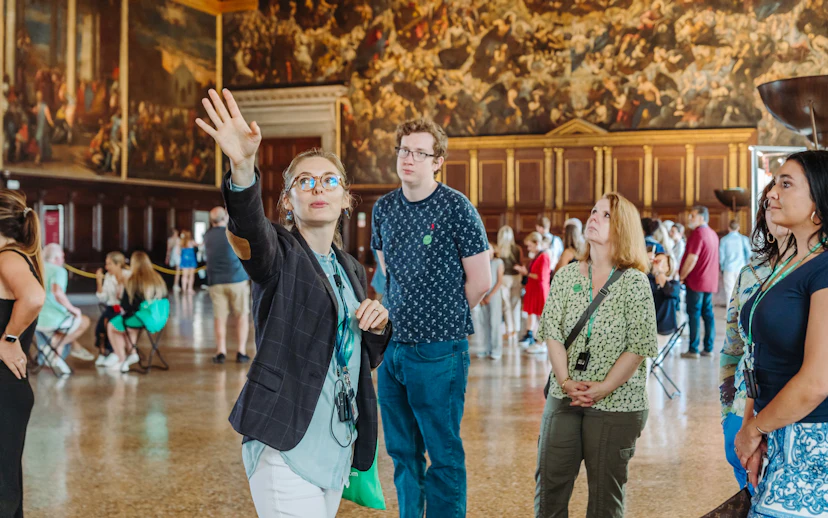
This is the room most visitors remember, and with good reason: it is monumental in scale and houses Paradise, one of the world's largest oil paintings. The full effect is less about one canvas and more about the feeling of standing in the political center of a republic that ruled for centuries. What people rush past is the ceiling — the gilded framework and historical paintings overhead are part of the same power display.
Where to find it: Near the end of the main state-room sequence on the upper floor, after the Senate and Collegio rooms.
Hall of the College
Artist: Paolo Veronese, Tintoretto, and workshop masters
The Hall of the College is smaller than the Grand Council Chamber, but many visitors find it more beautiful once they stop and look up. It was used to receive ambassadors, so every surface is designed to impress, especially Veronese's ceiling allegories. What gets missed is how intimate the room feels compared with the grander halls — it is one of the clearest glimpses of Venice staging power as theatre.
Where to find it: On the institutional-room route before the Grand Council Hall, reached after climbing the Golden Staircase.
Golden Staircase
Era: Mid-16th-century ceremonial staircase
The Scala d'Oro is not just a staircase between rooms; it was designed to overwhelm important visitors before they even reached the political heart of the palace. The gold stucco, white ornament, and rising perspective make it one of the building's most theatrical transitions. Most people photograph the lower portion and move on too quickly — the ceiling decoration overhead is the real reason to slow down here.
Where to find it: Immediately after the courtyard, leading up from the access level into the main visitor route.
Bridge of Sighs
Type: Historic enclosed bridge and prison passage
The Bridge of Sighs is famous from outside, but walking through it gives the story its emotional weight. The narrow passage and tiny stone-grilled windows make the crossing feel more constrained than most visitors expect, especially after the palace's ornate halls. What people miss is the view angle through the window openings — pause briefly and you'll understand why this became one of Venice's most loaded images.
Where to find it: On the standard route between the state rooms and the New Prisons.
New Prisons
Era: Early modern prison complex
The prisons change the mood of the visit completely, which is exactly why they matter. After gilded rooms and civic paintings, the cells, corridors, and stone surfaces show the punitive side of the same government. Many visitors move through quickly because the rooms are plain, but the contrast is the point — this section explains what the palace's judgments meant in practice.
Where to find it: Immediately after crossing the Bridge of Sighs on the main visitor route.
Armory rooms
Type: Weapons and military collection
The armory is one of the most consistently under-visited highlights in the palace. It holds armor, swords, firearms, and unusual devices that show Venice was not only a trading power, but a heavily armed state. Because it comes near the end, people often pass through tired or assume the best is over; in reality, it adds a harder, more strategic side to everything you've just seen upstairs.
Where to find it: Near the exit, after the prison section and before the café and gift shop area.
Facilities and accessibility
- 🎒 Cloakroom / lockers: Medium bags and backpacks may need to be deposited before entry, and bulky luggage is not allowed inside the palace route.
- 🚻 Restrooms: Restrooms are available on site, so use them before the prison section if you do not want to backtrack mentally through the one-way flow.
- 🍽️ Café: There is a café near the end of the route that works for a quick drink or reset, but most visitors still prefer a proper meal outside after the visit.
- 🛍️ Gift shop / merchandise: The gift shop sits near the exit and is strongest for art books, Venice-themed souvenirs, and museum publications rather than generic trinkets.
- 🪑 Seating / rest areas: Benches appear in some of the major rooms, and they are worth using in the Grand Council Hall if you want time with the paintings overhead.
- 📶 Wi-Fi: Connection can be limited once you're inside, so download any audio guide or digital ticket material before you arrive.
- ♿ Mobility: Most of the main route is accessible with ramps and elevators, but the Secret Itineraries route, parts of the prisons, and some narrower historic sections are not fully step-free.
- 👁️ Visual impairments: Guided tours and audio guide options add more value here than labels alone, because much of the palace experience depends on visual storytelling across large rooms and ceilings.
- 🧠 Cognitive and sensory needs: Opening hour is the easiest low-stimulation window, while late morning and early afternoon are the loudest because group tours stack up in the biggest ceremonial rooms.
- 👨👩👧 Families and strollers: The main palace route is manageable for many families, but tighter historic sections and the Secret Itineraries route are less practical with strollers than the standard visit.
Doge's Palace works best for school-age children who like stories, bridges, armor, and prison history more than long painting-heavy museum visits.
- 🕐 Time: 60–90 minutes is realistic with younger children if you focus on the courtyard, Golden Staircase, Bridge of Sighs, prisons, and armory.
- 🏠 Facilities: The cloakroom and restrooms make the visit easier with children, especially if you arrive with only a small day bag.
- 💡 Engagement: Frame the route as a journey from ruler to prisoner — palace rooms first, then the bridge, then the cells — and the visit becomes much easier for children to follow.
- 🎒 Logistics: Bring only a compact bag, arrive early, and skip overlong stops in the most crowded halls if attention is fading.
- 📍 After your visit: St. Mark's Square is right outside, so children can decompress quickly in the open space before you decide on the next stop.
Rules and restrictions
What you need to know before you go
- Entry requirement: Timed-entry tickets are tied to the date you book, so have your mobile ticket ready and carry ID if your booking or reduced fare requires verification.
- Bag policy: Suitcases, trolleys, and bulky bags are not allowed, and medium backpacks may need to be left at the cloakroom before you start the route.
- Re-entry policy: Plan your visit as one continuous circuit, because the palace is laid out as a one-way sequence from the main entrance to the exit near the armory.
Not allowed
- 🐾 Pets: Pets are not allowed inside the palace.
- 🖐️ Historic interiors: Do not cross barriers or touch painted walls, carvings, and historic furnishings, because much of the palace survives as fragile decorative fabric.

Photography
Personal photography is generally easiest when you keep it discreet and move with the route. Flash photography, tripods, selfie sticks, and commercial photography are not allowed, and the busiest ceremonial rooms are not the place to stop traffic for long photo setups. If a staff member restricts photography in a specific room or corridor, follow the room-level rule rather than assuming the same policy applies everywhere.

Good to know
- Included museums: Many Doge's Palace tickets also cover Museo Correr, the Archaeological Museum, and the Monumental Rooms of the Biblioteca Marciana, so check your ticket before buying anything extra in the square.
- Security checks: Skip-the-line entry helps with the ticket queue, not the security line, so even pre-booked visitors should still budget a short wait at busy times.
Practical tips
- Booking and arrival: Book morning slots first if you're visiting from April to October, and aim to arrive 10–15 minutes early so a security delay does not eat into your timed entry.
- Pacing: Save more energy than you think for the Grand Council Hall and the prison section, because the route's emotional payoff comes late and many visitors peak too early on the staircase and first chambers.
- Crowd management: The 9am–10:30am window works best here because Doge's Palace traffic is driven by St. Mark's Square overlap, not just by palace-only visitors.
- What to bring or leave behind: Bring a small bag, your ID, and pre-downloaded audio content if your ticket includes it; bulky bags slow the start of your visit because cloakroom use becomes another step before entry.
- Food and drink: Do the palace before lunch if you can, then eat after 1pm once you've cleared the heaviest room-to-room crowding; the on-site café is fine for a short break, but nearby sit-down spots are better for a proper meal.
- Ticket strategy: If you're deciding between standard entry and a guide, choose the guide when the politics and courtroom history matter to you, and choose audio when your priority is flexibility.
What else is worth visiting nearby?
Commonly paired: St. Mark's Basilica
Distance: 120 m — 2 min walk
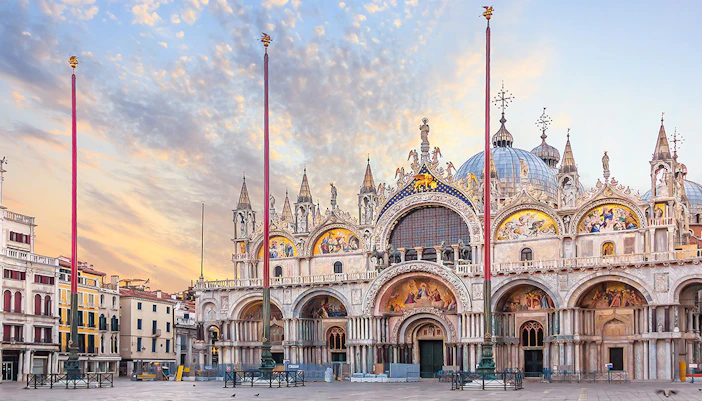
Why people combine them: They were once directly linked as Venice's political and religious center, and doing them together makes the palace rooms and basilica mosaics feel like one story instead of two separate stops.
Book / Learn more
✨ Doge's Palace and St. Mark's Basilica are most commonly visited together — and simplest to do on a combo ticket. Several options pair skip-the-line entry with either an audio guide or a live guide, which cuts duplicate planning and keeps both visits on one schedule.
Book Doge's Palace and St. Marks Basilica tickets
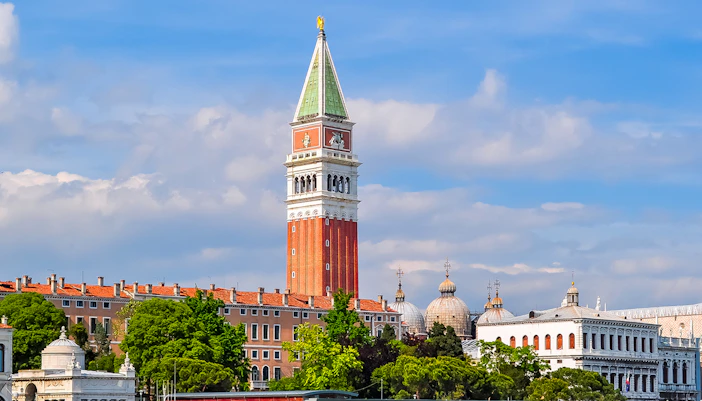
Commonly paired: St. Mark's Bell Tower
Distance: 180 m — 3 min walk
Why people combine them: After seeing the palace interiors, the bell tower gives you the opposite perspective — a quick overhead look at the square, lagoon edge, and the palace footprint itself.
St. Marks Bell Tower tickets
Also nearby
Museo Correr
Distance: 250 m — 3 min walk
Worth knowing: It is often included with Doge's Palace tickets, so it is one of the easiest worthwhile add-ons if you still have museum energy after the palace.
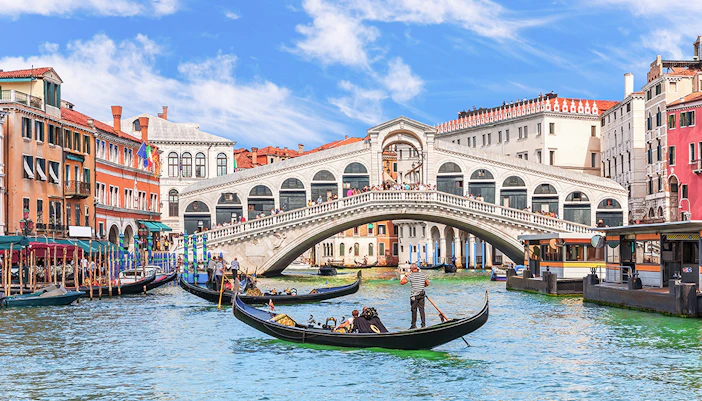
Rialto Bridge
Distance: 850 m — 12 min walk
Worth knowing: It is the most natural next stop if you're leaving San Marco on foot and want a scenic walk instead of another indoor attraction.
Eat, shop and stay near Doge's Palace
- On-site: The palace café near the exit is useful for coffee, cold drinks, and a short pause, but it works better as a convenience stop than as a full lunch plan.
- Caffè Florian (3 min walk, Piazza San Marco, 57): Historic café pricing and atmosphere, worth it if you want the full Venice setting more than a quick budget stop.
- Trattoria Al Gazzettino (8–10 min walk, San Marco 4971): Venetian classics in a dependable sit-down setting, making it a better post-visit meal than most square-side tourist menus.
- Riva-facing snack bars near San Zaccaria (5–7 min walk, lagoon side): Best when you want something fast before boarding a vaporetto rather than another formal meal.
- 💡 Pro tip: Eat after the palace, not before it, if you have a morning slot — the late-morning crowd peak hits the palace harder than the restaurants.
- Doge's Palace gift shop: Best for art books, exhibition catalogues, and Venice-themed keepsakes, and it is the most useful shopping stop if you want something tied directly to the visit.
- Museum book and souvenir counters around St. Mark's Square: Best for postcards, prints, and museum-style gifts if the main shop feels too busy right after the exit.
San Marco is the easiest base if Doge's Palace and St. Mark's Basilica are central to a short Venice trip. You can walk to the entrance in minutes and enjoy the square early or late, when the day crowds thin out. The trade-off is price and daytime congestion, so it works best for convenience-first stays rather than longer, more local-feeling ones.
- Price point: This area skews expensive, especially around the square and lagoon edge, with only a few value stays tucked into the smaller lanes.
- Best for: Short stays, first-time visitors, and anyone who wants to reach the palace at opening time without depending on transport.
- Consider instead: Dorsoduro or Cannaregio if you want better evening atmosphere, easier restaurant value, and a neighborhood that feels less packed once the day-trippers arrive.
Frequently asked questions about visiting Doge's Palace
Most visits take 1.5–2 hours for the main route. Plan closer to 2.5–3 hours if you use an audio guide carefully, spend time in the Grand Council Hall, or continue to the included Museo Correr, Archaeological Museum, and Marciana rooms afterward.
Yes, booking ahead is the safer choice from April to October, especially for morning entry and Secret Itineraries access. In quieter winter weeks, you can sometimes buy on the day, but you give up your preferred slot and risk starting later than planned.
Yes, it usually is during peak season and late-morning hours. Pre-booking will not remove security checks, but it can save you 30–60 minutes of ticket-line waiting when St. Mark's Square is at its busiest.
Arrive 10–15 minutes before your slot. That gives you enough buffer for security screening and ticket checks without standing around too long in a crowded square.
Yes, but keep it small. Medium backpacks may need to go to the cloakroom, and suitcases, trolleys, and bulky bags are not allowed inside the palace route.
Usually yes for personal use, but keep it discreet and assume room-level rules can vary. Flash photography, tripods, selfie sticks, and commercial photography are not allowed, and staff instructions always take priority inside the halls.
Yes, and it is one of the easiest Venice landmarks to do as a guided group visit. Group tours work especially well here because the political rooms, courtroom functions, and prison route make much more sense with explanation.
Yes, especially for children who like stories, bridges, armor, and prison history. Keep expectations realistic, focus on the courtyard, Golden Staircase, Bridge of Sighs, and armory, and aim for a 60–90 minute visit if younger children are with you.
Most of the standard visitor route is accessible with lifts and ramps. The main limitation is that the Secret Itineraries route, parts of the prison area, and some narrower historic sections are not fully accessible.
Yes, both on-site and nearby. The palace café is fine for a quick drink or reset, while the better meal options are outside in and around San Marco once you've finished the visit.
Yes, if you care about the mechanics of Venetian power rather than only the ceremonial rooms. It adds restricted areas, secret-state context, and prison sections that make the palace feel less like a grand museum and more like a functioning government.
Buy through the official channel or a verified partner with a clear timed-entry confirmation. That matters most around St. Mark's Square, where demand is high and a bad ticket can leave you back in the slowest queue.