Plan your visit to Teatro La Fenice
Teatro La Fenice is Venice’s historic opera house, best known for its gilded auditorium, dramatic fire-and-rebirth story, and deep ties to Italian opera. A visit is usually compact rather than exhausting, but it feels very different depending on when you go: on rehearsal or performance days, access can be more limited and the hall may be dimmed. Mid-morning is usually the sweet spot. This guide covers timing, routes, tickets, and what to prioritize once you’re inside.
Quick overview: Teatro La Fenice at a glance
If you’re fitting La Fenice into a wider Venice day, timing it right goes a long way.
- When to visit: Daily: 9:30am–6pm. 10:30am–12 noon is noticeably calmer than late afternoon, and you’re more likely to see the auditorium fully lit before rehearsals or performance prep affect the route.
- Getting in: From €12 for standard entry. Guided tours start from about €25. Booking ahead is smart in spring, summer, and on performance days, but same-day entry is often still workable in quieter months.
- How long to allow: 1–1.5 hours suits most visitors. Stretch it closer to 2 hours if you linger in the auditorium or browse the Maria Callas exhibition properly.
- What most people miss: The Maria Callas exhibition and the painted historic stage curtain. Both get skipped because visitors rush straight to the red-and-gold auditorium and back out again.
- Is a guide worth it? Yes, if you want the fires, restorations, and opera stories explained well; if you mostly want to admire the interiors at your own pace, the included audio guide is enough.
Jump to what you need
🕒 Where and when to go
🗓️ How much time do you need?
🎟️ Which ticket is right for you?
🗺️ Getting around
🎭 What to see
♿ Facilities and accessibility
Where and when to go
How do you get to Teatro La Fenice?
Teatro La Fenice is in the San Marco district, a short walk from Piazza San Marco and easy to fold into a central Venice sightseeing route.
Campo San Fantin, 1965, San Marco, 30124 Venice, Italy
- Vaporetto: Rialto → 10-min walk → a good option if you’re coming from Santa Lucia by Line 1.
- Vaporetto: San Zaccaria → 15-20-min walk → useful if you’re already around St. Mark’s Basin.
- On foot: Piazza San Marco → about 5-7 min → follow the shopping streets toward Campo San Fantin.
- On foot: Rialto Bridge → about 10 min → easiest if you’re linking it with the market area.
Which entrance should you use?
La Fenice has two primary entrances:
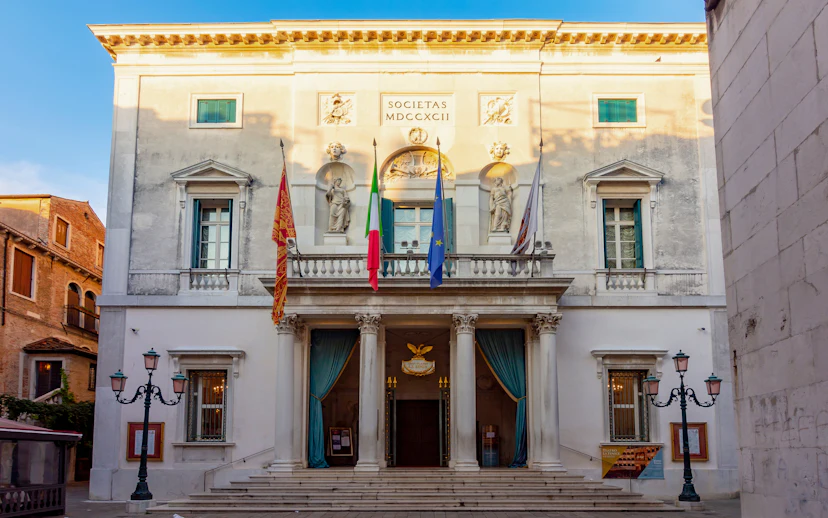
- For tourists/general visitors: Use the Main Portal in Campo San Fantin. This is the large, central entrance at the top of the stairs.
- Performance entrance: Attended by a doorman, this entry is exclusive for stage performers.
When is Teatro La Fenice open?
- Monday–Sunday: 9:30am–6pm
- Performance and rehearsal days: the public route can be adjusted and the auditorium may be dimmed
- Last entry: aim to arrive by 5pm if you want time for the auditorium and the Maria Callas exhibition
When is it busiest? Late morning through mid-afternoon in April–October is usually busiest, especially when Venice day-trippers fold La Fenice into a San Marco itinerary.
When should you actually go? Mid-morning usually works best because the hall is more likely to be fully viewable before late-day rehearsals, groups, or performance prep change the experience.
How much time do you need?
| Visit type | Route | Duration | What you get |
|---|---|---|---|
Highlights only | Entrance → foyer → main auditorium → royal box views → exit | 30-45 mins | Best for a quick look at the gilded auditorium and historic interiors. |
Full exploration | Entrance → foyer → auditorium → boxes/loggias → Apollonian rooms → exhibition areas → time for exhibitions/bookshop | 75-90 mins | Adds more time for photos, audio-guide commentary, and the theater’s restoration story. Worth it with a guided tour, but not essential for a casual visit. |
Which Teatro La Fenice ticket is best for you?
| Ticket type | What's included | Best for | Price range |
|---|---|---|---|
Standard audio-guided admission | Entry + audio guide + Maria Callas exhibition | A first visit where you want the full core route without being locked into a group pace. | From €12 |
Guided tour | Entry + live guide + theater history + public visit route | A visit where you want the fires, premieres, and restoration details explained as you go. | From €25 |
Combo tickets | Theater entry + access to Doge's Palace + Venice's civic museums | An all-in-one, budget-friendly combo offering maximum city coverage | From €43 |
How do you get around Teatro La Fenice?
Inside the theater
La Fenice is compact and mostly linear for daytime visitors, so it’s easy to self-navigate once you’re inside. What changes the experience isn’t the size of the building but whether the day’s route includes full auditorium access or a slightly restricted version.
- Foyer and entrance rooms: box office, orientation point, and first architectural details → 10–15 min
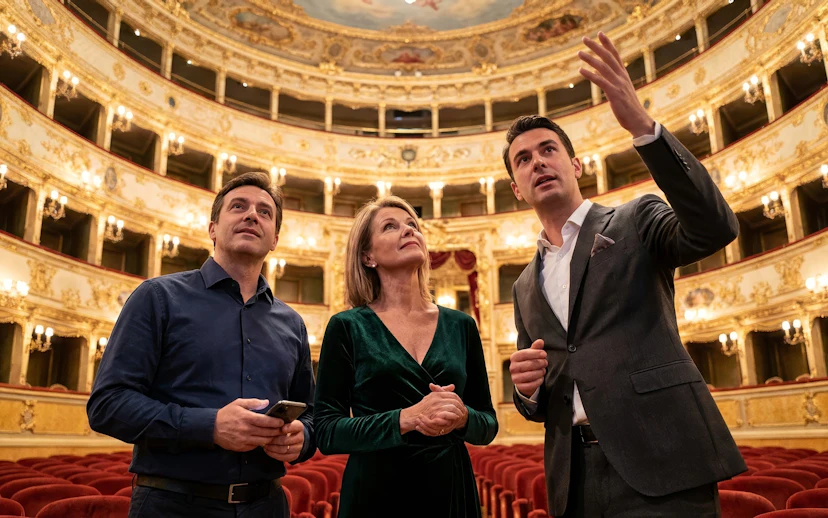
- Grand Auditorium: red velvet stalls, gilded boxes, painted ceiling, and stage view → 20–30 min
- Royal Box and upper viewing points: best angles over the horseshoe-shaped hall → 10–15 min
- Maria Callas exhibition: photos, posters, and memorabilia from her Venice years → 15–20 min
Suggested route: Start with the auditorium while your attention is fresh, then move to the upper levels and finish with the Maria Callas exhibition — most visitors do the reverse and end up rushing the theater’s quietest, richest spaces.
What are the most significant spaces in Teatro La Fenice?

Grand Auditorium
Era: Late-18th-century theater recreated after the 1996 fire and reopened in 2003
This is the room most people come for: a horseshoe-shaped opera house wrapped in deep red velvet, gold leaf, chandeliers, and stacked boxes. It’s visually overwhelming in the best way, but the detail most visitors miss is the painted ceiling above them because they spend the whole stop looking straight at the stage.
Where to find it: Through the main public route beyond the foyer, at the heart of the theater
Royal Box
Type: Ceremonial box for distinguished guests and state presence
The Royal Box gives you one of the clearest reads of the theater’s social hierarchy and sightlines in a single glance. Notice how the box anchors the room’s symmetry and shows how La Fenice was built to be seen as much as heard.
Where to find it: Off the main auditorium route, overlooking the central hall
Proscenium arch and historic curtain
Type: Decorative stage architecture with surviving historic visual elements
The stage framing is easy to overlook because the boxes and ceiling steal attention first, but it’s one of the clearest reminders that this is still a working opera house, not just a museum piece.
Where to find it: At the front of the Grand Auditorium, directly above and around the stage
Maria Callas exhibition
Type: Permanent exhibition dedicated to Maria Callas’s Venice years
This small museum section rewards anyone who wants more than architecture. It includes photos, posters, and original memorabilia tied to Callas’s performances in Venice from 1947 to 1954, and the detail people rush past is how personal the material feels compared with the grandeur of the hall outside.
Where to find it: In the Teatro La Fenice Museum area on the daytime visitor route
Backstage-facing public route
Type: Behind-the-scenes visitor perspective during official tours
You won’t get a full backstage production experience, but even the public touring corridors shift the visit from beautiful room to living theater. The stories of fire, reconstruction, and stagecraft make the gilded auditorium feel less static and more hard-won.
Where to find it: Along the guided or official public route connected to the main auditorium visit
Facilities and accessibility
- 🍽️ Apollinean Café: The on-site café in Sale Apollinee is a convenient stop for coffee or a light break and is typically open Tuesday–Sunday, 10am–4pm.
- 🛍️ Gift shop: Most visits end near the foyer shop, where you can browse books, music-themed souvenirs, and theater keepsakes without adding much extra time.
- 🚻 Restrooms: Public restrooms are available within the visitor areas, so you don’t need to leave the building mid-visit to find them.
- ♿ Mobility: Ground-level access is wheelchair-friendly and elevators reach the foyers, but some historic boxes and upper viewing areas still involve stairs, so access is partial rather than fully step-free.
- 👁️ Visual impairments: The included audio guide helps with context and pacing, though the experience still relies heavily on seeing architectural details inside the hall.
- 🧠 Cognitive and sensory needs: Mid-morning tends to be the calmest window, while rehearsal or performance prep can mean dimmer lighting and a less predictable atmosphere inside the auditorium.
- 👨👩👧 Families and strollers: The public route is manageable with a compact stroller in the main visitor areas, but upper-level historic sections can be slower and more awkward because of stairs.
La Fenice works best with children who can slow down, look up, and listen a little; it’s more rewarding for school-age kids than for toddlers who need constant hands-on activity.
- 🕐 Time: Around 30–45 min is realistic with younger children, and the auditorium plus the Maria Callas exhibition are the best parts to prioritize.
- 🏠 Facilities: The on-site restrooms and short route make this easier than a large museum, especially if you’re fitting it between other central Venice stops.
- 💡 Engagement: Ask children to count the tiers of boxes and spot the most ornate gold details — it turns the auditorium into a simple visual game.
- 🎒 Logistics: Bring a small bag, not a bulky daypack, and aim for mid-morning when the route is calmer and kids are less likely to get restless.
- 📍 After your visit: Piazza San Marco is close enough for an easy follow-up walk where children can stretch their legs immediately after the tour.
Rules and restrictions
What you need to know before you go
- Entry requirement: Standard daytime visits use an admission ticket, while performance entry requires the separate ticket for that specific show.
- Booking method: Pre-booking is the safer option in spring, summer, and on performance days because same-day availability is less predictable.
- Bag policy: Keep bags small and easy to carry because this is a compact historic venue, not a place built for large luggage.
- Re-entry policy: Plan to finish the visit in one go because stepping out can interrupt a short route that only really works when done continuously.
- Dress note: There’s no formal dress code for daytime visits, but evening performances skew smarter than a standard sightseeing stop.
Not allowed
- 🚫 Tripods and formal photo shoots: Handheld photos are fine during tours when no rehearsal is underway, but tripods and wedding-style photography are not permitted.
- 🖐️ Off-route access: Visitor access stays within the public touring areas, and any deeper backstage sections depend on the official route for that day.
Photography
Photography is generally permitted during daytime visits when there is no rehearsal or performance conflict, and that’s the key distinction to understand before you go. Rules can tighten around the auditorium depending on what is happening on stage, so don’t assume the same freedom on every visit. Handheld photography is the safest expectation; tripods and formal shoots are not allowed.
Good to know
- Late arrival: For performances, late seating is not allowed, so arriving 30 min early matters more here than at a typical museum.
- Access changes: On performance days, the biggest surprise is not the queue but the possibility of seeing the auditorium dimmed or with a shorter public route.
Practical tips
- Booking and arrival: Book ahead if you’re visiting in April–October or on a day with an evening performance, and aim to arrive at least 15 min early for a daytime visit so you’re not collecting your audio guide during the busiest part of the queue.
- Pacing: Don’t treat the auditorium as a quick photo stop — give it a full 20–30 min first, because the Maria Callas exhibition is easier to absorb even if you’re short on time later.
- Crowd management: Mid-morning works best here not just because it’s quieter, but because you’re more likely to catch the hall before late-day rehearsals or lighting changes affect the atmosphere.
- What to bring or leave behind: Bring a small bag and leave bulky luggage elsewhere; this is a compact historic theater, and carrying a large pack through foyers and stairs only slows you down.
- Food and drink: If you want a light break without losing time, use the Apollinean Café before or after the visit rather than trying to build a full lunch stop into a 1-hour route.
- Performance nights: If you’re attending a show instead of a daytime tour, arrive 30 min early and settle in — the evening experience is about the atmosphere as much as the curtain time.
- Best pairing: La Fenice works especially well before lunch or in the late morning, then followed by a walk toward Piazza San Marco or Rialto instead of being saved for the rushed end of the day.
What else is worth visiting nearby?
Commonly paired: Doge’s Palace
Distance: About 1km — around 15 min walk
Why people combine them: Both deepen the ‘grand Venice’ experience, but in very different ways — one through political power and art, the other through opera, interiors, and performance history.
Commonly paired: St. Mark’s Basilica
Distance: About 1km — around 15 min walk
Why people combine them: It’s an easy same-area pairing if you’re already spending time around San Marco and want architecture that feels completely different in mood and scale.
Also nearby
Rialto Bridge and Market
Distance: About 700m — around 10 min walk
Worth knowing: This is the easiest post-visit add-on if you want to swap velvet-and-gold interiors for a lively Venice street scene.
Peggy Guggenheim Collection
Distance: About 900m — around 12 min walk
Worth knowing: It’s a strong contrast to La Fenice because you go from historic opera-house grandeur to modern art in a manageable same-day cultural pairing.
Eat, shop and stay near Teatro La Fenice
- On-site: Apollinean Café, near the lobby, is the easiest option for coffee or a quick break and is worth it for convenience rather than for turning into a full meal stop.
- Pro tip: If you’re visiting close to 12 noon, do the theater first and eat after — the route is short, and breaking it up for food makes less sense than finishing cleanly and heading out toward San Marco or Rialto.
- Teatro La Fenice foyer shop: Theater-themed souvenirs, books, and music-related keepsakes in the foyer area, and it’s the most practical place to buy something small without detouring from your route.
Staying near La Fenice works well if you want a polished, central Venice base and plan to spend a lot of your trip on foot around San Marco. The trade-off is price: this area is usually more expensive and more crowded than neighborhoods where Venice feels a little less polished and more lived-in. It’s a strong fit for short stays, but not automatically the smartest base for every budget.
- Price point: This area generally skews upscale, with the biggest premium coming from being walkable to San Marco and the Grand Canal.
- Best for: Visitors on a short Venice trip who want minimal logistics, evening walkability, and easy access to major landmarks.
- Consider instead: Dorsoduro or Cannaregio if you want a more relaxed base, better value, and a neighborhood that feels easier to return to after the day-tripper crowds thin out.
Frequently asked questions about visiting Teatro La Fenice
Most daytime visits take about 1–1.5 hours. That’s enough time for the auditorium, the audio guide, and the Maria Callas exhibition without rushing. If you like architecture and linger in the main hall or stop at the café, plan closer to 2 hours.
No, you don’t always need to, but booking ahead is the safer choice in spring, summer, and on performance days. Same-day tickets can still work in quieter months, but pre-booking removes the risk of turning up when access is limited or the preferred slot has filled.
Arrive about 15 min early for a daytime visit and 30 min early for a performance. Daytime visits move more smoothly if you’re not collecting your ticket or audio guide at the last minute, while evening performances are stricter because late seating is not allowed.
Yes, but a small bag is much more practical than a large backpack. La Fenice is a compact historic theater with stairs and tight circulation points in parts of the route, so bulky luggage makes the visit slower and less comfortable even if you’re only inside for 1 hour.
Yes, handheld photography is generally allowed during daytime visits when there isn’t a rehearsal or performance conflict. The important detail is that rules can change depending on what’s happening on stage, so don’t assume every visit offers the same photo access. Tripods and formal photo shoots are not permitted.
Yes, and private or group tours are available by reservation. Group and guided visits make the most sense if you want live commentary rather than the standard audio guide, especially for the theater’s fire history, restorations, and opera premieres. If your group is large, book early instead of relying on same-day arrangements.
Yes, especially for school-age children who can engage with the setting for 45–60 min. The route is short enough for families, and the auditorium is visually striking even for children who aren’t interested in opera. Very young kids may find it less rewarding because it’s a look-and-listen visit rather than a hands-on one.
Partly, yes. Ground-level access is wheelchair-friendly, and elevators reach the foyers, but some historic boxes and upper sections still require stairs. It’s better to think of La Fenice as partially accessible rather than fully step-free from end to end.
Yes. The easiest on-site option is the Apollinean Café in Sala Appollinee, which works well for coffee or a light break rather than a full meal. Because the visit itself is short, many people find it simpler to eat afterward in the San Marco or Rialto direction.
Yes, and that’s how many visitors experience it. Standard daytime visits focus on the theater interiors, history, and the Maria Callas exhibition, so you don’t need a performance ticket to see La Fenice. An opera ticket is a separate experience and usually turns the visit into a 2–3-hour evening.
Yes, the Maria Callas exhibition is included with the standard visit. It’s one of the easiest parts of the experience to miss because people often treat La Fenice as only an architecture stop. Set aside at least 15 min if you want more than a quick pass through.